


The default move under pressure
The pattern shows up at scale, and the data confirms it.
A June 2026 Gartner survey of 426 senior marketing leaders found that 84% of companies sit inside what the researchers describe as a brand doom loop. These organizations put too little into measuring their brand, so they cannot demonstrate its effect on growth, so the funding for foundational work shrinks further. The cycle pushes budgets toward execution and away from the underlying strategic question.
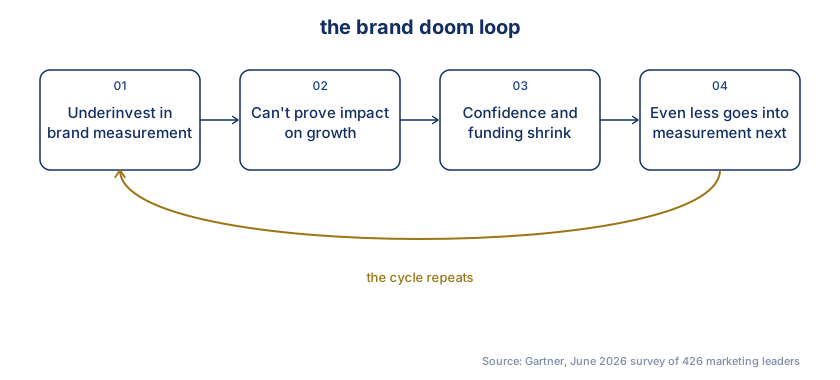
Money flows toward activity because activity is easy to justify. Direction is harder, simply because proving it takes longer.
The cost of that reflex is already severe before positioning even enters the picture. Research from the ANA and WFA on programmatic advertising found that roughly $439 of every $1,000 spent actually reaches a consumer as a viewable impression. Fees, fraud, and inefficiency in the delivery chain absorb the rest.
To be precise: unclear positioning does not cause that specific loss. The delivery chain does. But the number tells us something important. Even in a perfectly efficient system, spend only carries whatever signal you feed into it. In the real system, that signal arrives thinned out and expensive already. Feeding it an unclear message compounds the waste on top.
Marketing amplifies, it does not originate
Here is the pattern underneath the pattern.
Marketing is an amplifier. It takes a signal that already exists and makes it louder, wider, more frequent. It has no capacity to create that signal in the first place.
A clear position gets amplified into something sharper, every dollar carrying the same message further. An unclear one gets amplified into something louder instead, that’s the whole difference. The market hears more of what it already cannot place, and the company pays a premium for the privilege.
The same Gartner research quantifies the gap. Companies with a strong, well-articulated brand strategy are roughly twice as likely to exceed their growth targets. Companies caught in the doom loop are about half as likely. The variable that moves the outcome is the quality of the strategy, not the volume of spend behind it.
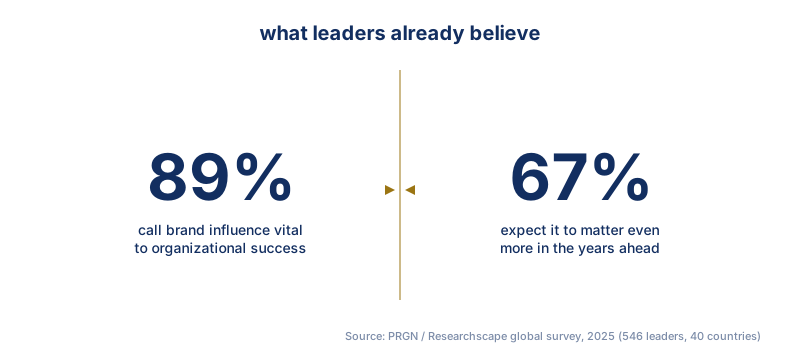
Leaders largely know this. A 2025 global survey by PRGN and Researchscape, covering 546 business leaders across 40 countries, found that 89% consider brand influence vital to organizational success, and 67% expect it to matter even more in the years ahead. Yet close to half of those same leaders rate their own execution as needing improvement. The knowledge is there. The foundation, in most of these companies, is not.
The field commander understands this distinction instinctively. Resources committed before the terrain is read are resources committed blind. Reading the terrain first looks slower. It is the only thing that makes speed useful.
Stalled growth is usually a naming problem
The implication is less comfortable than the observation.
Most stalled growth has little to do with visibility. It traces back to the fact that no one inside the company has named, with precision, what the company is and why it matters. That absence is invisible from the inside, because everyone carries their own private version of the answer. The gaps only show up externally, in messaging that shifts from quarter to quarter and in campaigns that each pull in a slightly different direction.
It is also more widespread than most leadership teams assume. One recent national survey in Japan, conducted by Tanabe Consulting in late 2024 with 338 respondents, found that just under half of companies had a documented brand strategy at all. That is one regional data point, offered here as illustration rather than a global claim. It still suggests how often companies amplify a position that was never actually written down.
The environment has also become far less forgiving of ambiguity. The 2025 Edelman Trust Barometer found that among people who use generative AI, 91% use it to research companies, compare products, or summarize reviews before buying. The market now forms its view of a business through compressed, machine-summarized signals before that business’s marketing ever gets a hearing.
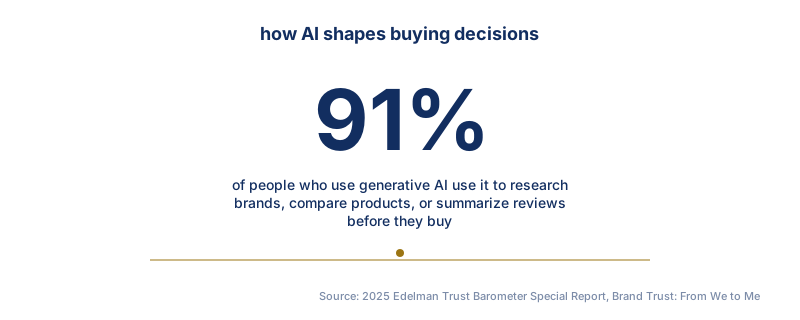
An unclear position gets no second chance inside that compression. It gets summarized as confusion, and the summary travels.
Naming the essence of a company with that level of precision is foundation work. It calls for perspective, discipline, and honest internal alignment, a different job than a campaign, done by different means, and it has to come before action for the action to compound.
Name the problem before you fund the solution
Before commissioning any marketing, or replacing anyone on the team, name which problem you actually have.
A reach problem exists when the position is sharp, the message is consistent, the market responds well wherever it hears you, and the only constraint is that too few people have heard you yet. Distribution, media, and frequency solve that, because the signal is already worth amplifying.
A clarity problem exists when the leadership team gives different answers to the question of what the company stands for. When the website says one thing, the sales conversations say another, and the last three campaigns each tested a new identity. Or when prospects respond well in the room and still struggle to explain what you do to their colleagues afterward.
That calls for foundation work instead: structure, alignment, a position defined precisely enough that everything downstream inherits it.
Mistaking one problem for the other is where budget goes to die. Spending reach money on a clarity problem buys louder confusion. Doing clarity work when the real constraint is distribution delays growth you had already earned.
The diagnosis costs nothing. Skipping it costs everything that follows.
An honest question to sit with
We will leave you with an invitation rather than a pitch, because this is a foundation, and foundations deserve reflection before commitment.
Before the next campaign brief gets written, or anyone gets replaced, sit with your leadership team and answer honestly: if you doubled the marketing budget tomorrow, would the market hear a clearer version of you, or simply a louder one. Write the answer down. Compare notes across the room. The founder who recognizes a clarity problem in that conversation has already done the hardest part, which is seeing it. That recognition marks readiness for a foundation conversation, and it deserves to happen before any brief gets commissioned.
Sources
Gartner, Gartner Marketing Survey Finds 84% of Companies Are Stuck in a “Brand Doom Loop” (Jun-2026)
Gartner, Gartner Predicts Over 40% of CMOs Who Push for Larger Brand Budgets Will Lose Influence With the C-Suite (Feb-2026)
WFA / ANA, ANA’s 2024 Programmatic Benchmark Study (2025)
PRGN / Researchscape, Trust, Digital Strategies and Customer Loyalty Drive Brand Influence (2025)
Tanabe Consulting, 2024年度 ブランディングに関するアンケート (Jan-2025)
Edelman, 2025 Edelman Trust Barometer Special Report: Brand Trust, From We to Me